Advertiser Disclosure

Last update: October 13, 2025

7 minutes read
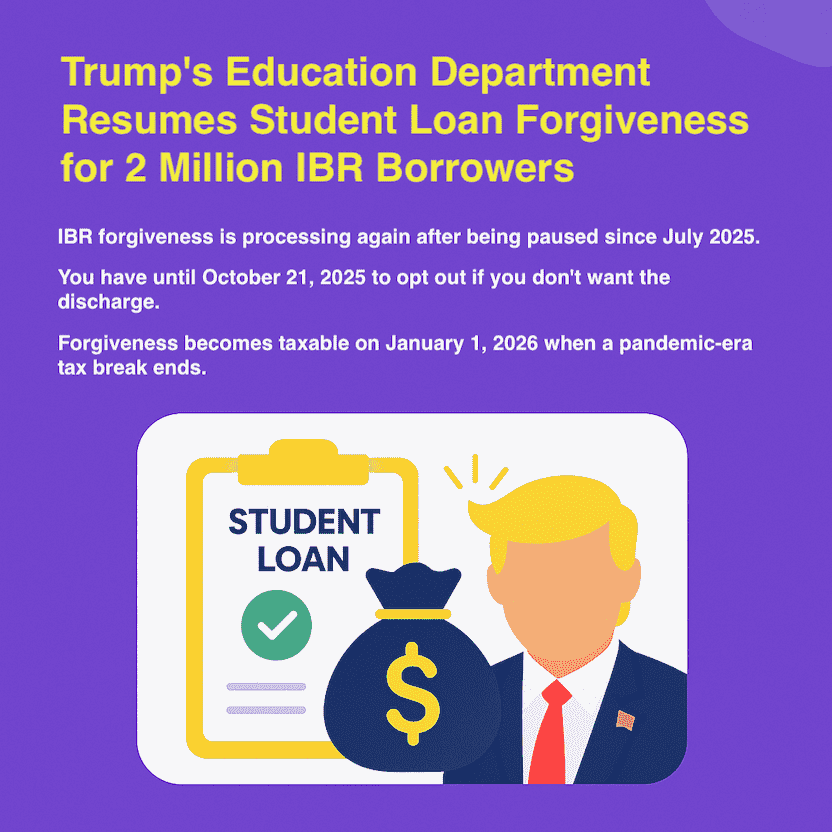
Trump's Education Department Resumes Student Loan Forgiveness for 2 Million IBR Borrowers
Did you get an email about student loan discharge? Income-Based Repayment forgiveness just resumed after months on pause. Here's what happens next and why timing matters.

By Derick Rodriguez, Associate Editor
Edited by Yerain Abreu, M.S.
Learn more about our editorial standards



By Derick Rodriguez, Associate Editor
Edited by Yerain Abreu, M.S.
Learn more about our editorial standards
Got an email saying your student loans are getting canceled? You're not alone.
The Department of Education just started sending these emails to people on Income-Based Repayment plans. If you've been making payments for 20 or 25 years, this is the moment you've been waiting for.
About 2 million people are in IBR plans right now. Many of them are finally getting the loan forgiveness they were promised when they started.
But here's the thing: you need to act fast if you want to make any changes. And the timing could save you thousands in taxes.

Key takeaways
- IBR forgiveness is processing again after being paused since July 2025
- You have until October 21, 2025 to opt out if you don't want the discharge
- Forgiveness becomes taxable on January 1, 2026 when a pandemic-era tax break ends
What is income-based repayment?
Income-Based Repayment is a federal program that bases your monthly payment on what you actually earn. Here's how it works:
Your monthly payment:
- Based on your income (not your loan balance)
- Capped at a percentage of your "discretionary income"
- Could be as low as $0 if you don't earn much
- Stays affordable even if your balance grows
The payoff:
- Make payments for 20 years (if you borrowed after July 1, 2014)
- Or 25 years (if you borrowed before that date)
- Whatever's left gets forgiven
- You stop owing money

TuitionHero Tip
IBR is just one type of income-driven repayment plan. Others include PAYE, REPAYE, and the newer SAVE plan. Each has different rules.
Why did forgiveness get paused?
In July 2025, the Department of Education paused IBR forgiveness. The reason? They needed to check everyone's payment counts.
Payment counts are how the government tracks whether you've made enough payments to qualify for forgiveness. If those numbers are wrong, some people might get forgiveness too early. Others might wait longer than they should.
And payment counts have been a mess. Loan servicers changed over the years. Some payments didn't get recorded. People lost years of credit.
So the department paused everything to fix the numbers. Now they're moving forward again.
What happens next
Here's what you can expect if you got a discharge email:
Date | What Happens |
|---|---|
Now through October 21 | You can opt out by contacting your loan servicer |
After October 21 | Department sends your discharge info to your servicer |
Next 2-8 weeks | Your servicer processes the forgiveness |
When it's done | Your loan balance drops to zero |
Tax season 2026 | You get a 1099-C form showing the canceled amount |
The tax situation you need to understand
This is the most confusing part, so let's break it down.
Right now (through December 31, 2025):
- Forgiven student loans = no federal taxes
- Thanks to the American Rescue Plan from 2021
- You pay $0 in federal taxes on forgiven debt
Starting January 1, 2026:
- Forgiven student loans = taxable income
- Gets added to your income for the year
- You owe regular income tax on it
Compare private student loans now
TuitionHero simplifies your student loan decision, with multiple top loans side-by-side.
Compare Rates
Here's what that means in real numbers
Let's say you have $50,000 forgiven.
If forgiveness happens in 2025:
- Federal taxes owed: $0
- State taxes: Depends on your state
- Total tax bill: $0 to ~$2,500 (state only)
If forgiveness happens in 2026:
- $50,000 gets added to your taxable income
- If you're in the 22% tax bracket: $11,000 in federal taxes
- Plus state taxes: ~$2,500
- Total tax bill: ~$13,500
That's a huge difference.
Should you opt out?
Most people should take the forgiveness. But there are a few situations where opting out makes sense.
1. You can't afford the tax bill
- Your loans are getting forgiven in 2026 or later
- The tax bill would be thousands of dollars
- You don't have savings to cover it
2. Your state will tax it anyway
- Some states tax forgiven loans even when the federal government doesn't
- Check your state's rules
- If you'll owe taxes either way, you might want more time to save
3. You're almost done paying anyway
- You only have a few thousand left
- You could pay it off in the next year
- The tax bill would be close to what you still owe
Reasons to take the forgiveness:
- You have a large balance ($20,000+)
- Your loans are being discharged in 2025 (no federal taxes)
- You can afford the tax bill or set up a payment plan with the IRS
- You're tired of making payments
TuitionHero Tip
Even if you owe taxes on forgiveness, it's usually still cheaper than paying off the full loan balance yourself.
How to opt out (if you decide to)
If you want to opt out, follow these steps:
- Step 1: Contact your loan servicer before October 21, 2025
- Step 2: Tell them you want to opt out of IBR discharge
- Step 3: Get confirmation in writing (email or letter)
- Step 4: Keep making your monthly payments
You can find your servicer by logging into StudentAid.gov.
What if you do nothing?
If you got the email and you don't contact your servicer, here's what happens:
- After October 21, your info gets sent to your servicer
- Your servicer processes the discharge (usually 2 weeks)
- Your loan balance goes to $0
- You stop making monthly payments
- You get a 1099-C form at tax time
That's it. You don't need to fill out forms or call anyone. It happens automatically.
State-by-state tax rules
Whether you owe state taxes on forgiven loans depends on where you live.
States that DON'T tax forgiven student loans:
- California
- New York
- Pennsylvania
- Many others
States that DO tax forgiven loans:
- Mississippi
- North Carolina
- Wisconsin
- Check your state's department of revenue website
States with no income tax:
- Alaska
- Florida
- Nevada
- South Dakota
- Tennessee
- Texas
- Washington
- Wyoming
- You won't owe state taxes on forgiveness
What to do right now: Your action checklist
If you got the discharge email:
- Check if your state taxes forgiven student loans
- Calculate how much you might owe in taxes
- Decide if you want to opt out
- Contact your servicer by October 21 if opting out
- [ ]Keep making payments until you see $0 balance
If you think you're eligible but didn't get an email:
- Log into StudentAid.gov
- Check your payment count
- Contact your servicer to ask about your status
- Update your email address with your servicer
To calculate your potential tax bill:
- Find out your tax bracket (use the IRS website)
- Multiply your forgiven amount by your tax rate
- Check if your state taxes forgiven loans
- Add state taxes to federal taxes
- That's roughly what you'd owe
TuitionHero Tip
If you're close to forgiveness now, get it while you can. The rules might be different next year.
What's changing with student loans overall
While IBR forgiveness is processing, bigger changes are coming to student loan repayment.
The Trump administration is planning to:
- Eliminate current income-driven repayment plans
- Replace them with two new, less generous options
- Focus less on loan forgiveness overall
- Expand help for borrowers choosing repayment options

Why trust TuitionHero
At TuitionHero, we help you find the best private student loans by comparing top lenders and breaking down eligibility, interest rates, and repayment options. Whether you need additional funding beyond federal aid or a loan without a cosigner, we simplify the process. We also provide expert insights on refinancing, FAFSA assistance, scholarships, and student credit cards to support your financial success.
Frequently asked questions (FAQ)
Depends on when your loans get canceled. Forgiveness in 2025 = no federal taxes. Forgiveness in 2026 or later = yes, you'll owe federal taxes. Your state might tax it either way.
You have options. Set up a payment plan with the IRS (they allow this).
Apply for hardship status if you qualify. Or opt out now and save up money while you keep making loan payments. Talk to a tax professional.
Maybe. If you combined Direct Loans with other Direct Loans, you're probably okay. But if you consolidated FFEL or Perkins loans into Direct Loans, your payment clock might have restarted. Call your servicer to check.
It might drop a little when the accounts close. This happens because you're losing credit history. But the drop is usually small and temporary. Most people's scores recover quickly.
PSLF takes 10 years instead of 20-25. It's also always tax-free. You can't get both. Whichever one you reach first is the one you'll get. If you're close to PSLF, that's probably better.
Final thoughts
You've been paying on these loans for years. Maybe decades. You've earned this forgiveness.
Yes, the tax situation is annoying. Yes, the system could be simpler. But for most people with big balances, forgiveness is still way better than paying everything back.
The October 21 deadline is coming fast. Figure out what makes sense for your situation. Check your state's tax rules. Do the math.
And if you have questions about whether to take forgiveness, refinance, or try a different strategy, TuitionHero can help you figure it out. You're so close to being done with these loans. Don't let confusion or missed deadlines get in your way.
Source
Author
Derick Rodriguez
Derick Rodriguez is a seasoned editor and digital marketing strategist specializing in demystifying college finance. With over half a decade of experience in the digital realm, Derick has honed a unique skill set that bridges the gap between complex financial concepts and accessible, user-friendly communication. His approach is deeply rooted in leveraging personal experiences and insights to illuminate the nuances of college finance, making it more approachable for students and families.

Editor

Yerain Abreu
Yerain Abreu is a Content Strategist with over 7 years of experience. He earned a Master's degree in digital marketing from Zicklin School of Business. He focuses on college finance, a niche carved out of his journey through the complexities of academic finance. These firsthand experiences provide him with a unique perspective, enabling him to create content that's informative and relatable to students and their families grappling with the intricacies of college financing.

At TuitionHero, we're not just passionate about our work - we take immense pride in it. Our dedicated team of writers diligently follows strict editorial standards, ensuring that every piece of content we publish is accurate, current, and highly valuable. We don't just strive for quality; we aim for excellence.
Related posts
While you're at it, here are some other college finance-related blog posts you might be interested in.
3 minutes read
Where Did Morgan Wallen Go to College? The Unexpected Path of a Country Star
Did Morgan Wallen go to college? See how a baseball injury changed his plans and how students can learn from his journey.
Learn More

5 minutes read
How to Build a Strong Resume for Internships
Wondering how to craft a compelling internship resume that grabs attention? Discover essential strategies to build a standout resume and secure your dream internship.
Learn More

8 minutes read
How to Get Your Student Loans Forgiven
Learn how to erase student loan debt with our top strategies for Public Service Loan Forgiveness, including employer tips and payment plans.
Learn More

Shop and compare student financing options - 100% free!

Always free, always fast
TuitionHero is 100% free to use. Here, you can instantly view and compare multiple top lenders side-by-side.

Won’t affect credit score
Don’t worry – checking your rates with TuitionHero never impacts your credit score!

Safe and secure
We take your information's security seriously. We apply industry best practices to ensure your data is safe.
Finished scrolling? Start saving & find your private student loan rate today
Compare Personalized Rates